
7 Hidden Ways Growing Up with an Alcoholic Parent Shapes Your Adult Life (And How to Start Healing)
For adult children of alcoholics who want clarity, compassion, and a path forward
If you grew up with an alcoholic parent, you already know it changes you. But what many adult children of alcoholics don’t realize is how deeply that childhood environment continues shaping their emotional world, relationships, and sense of self long into adulthood.
Some of these patterns are obvious.
Others are so subtle (and so normalized!) that you may not even recognize them as effects of your childhood.
In this post, we’ll walk through seven hidden ways growing up with an alcoholic parent impacts your adult life, why these patterns form, and what you can do to gently begin unraveling them.
And if you want help getting started with healing, don’t miss the free healing guide at the bottom of this post.
Why Your Childhood Still Affects You Today
When you’re raised in a home with addiction, you adapt quickly. You learn to stay alert, stay small, stay responsible, stay invisible, stay helpful — anything to survive the unpredictable environment around you.
This becomes your operating system.
The problem? Those same survival skills that protected you in childhood often work against you in adulthood.
You may feel:
- constantly on edge
- responsible for everyone else
- disconnected from your own needs
- ashamed of having emotions
- afraid of conflict
- unsure how to trust yourself or others
None of these traits mean something is wrong with you. They mean you adapted exceptionally well to a chaotic environment and no one ever told you that you’re allowed to stop surviving now.
Let’s talk about those hidden patterns — the ones most people never connect to growing up with an alcoholic parent.
1. You Over-Function in Relationships
As a child, you may have become “the responsible one,” stepping in to hold the household together or protect younger siblings.
As an adult, this often looks like:
- taking on too much
- being the emotional support person for everyone
- saying “yes” even when you’re depleted
- feeling guilty when you rest
Society praises this, which makes it even harder to see the burnout underneath.
How to break the pattern:
Pause before saying yes. Ask yourself:
“If I agree to this, do I have the energy for what matters most this week?”
2. You Feel Unsafe When Life Is Calm
Calm may not feel like calm — it may feel like “the calm before the storm.”
This is hypervigilance: your nervous system constantly scanning for danger because, as a child, you never knew when the mood at home would suddenly shift.
You may catch yourself thinking:
- “Things are going too well…”
- “What’s about to go wrong?”
How to break the pattern:
Create short “peace practices.”
For 30 seconds, notice something good or safe in the present moment.
Over time, your body learns that peace can be trusted.
3. You Avoid Conflict at All Costs
Conflict may have been emotionally or physically unsafe in your childhood home.
Now, you might:
- stay quiet to “keep the peace”
- avoid sharing your preferences
- over-accommodate people
- panic when someone is frustrated
Conflict feels dangerous because it was dangerous.
How to break the pattern:
Practice in low-stakes situations:
- choosing the restaurant
- saying “I’d prefer this instead”
- disagreeing gently
Your voice strengthens through repetition.
4. You Don’t Trust Yourself
Children of alcoholic parents often learn that their perceptions are “wrong.”
You may have been told:
- “You’re exaggerating.”
- “That didn’t happen.”
- “You’re too sensitive.”
As an adult, you might:
- second-guess decisions
- defer to others
- ask multiple people for reassurance
- fear making the “wrong” choice
How to break the pattern:
Create a “proof list.”
Every time you make a good call — big or small — write it down.
You’re rebuilding your internal trust one piece at a time.
5. You Over-Apologize (Even When You Did Nothing Wrong)
“Sorry” becomes a reflex for many adult children of alcoholics.
It was a childhood survival strategy — a way to prevent anger, tension, or outbursts.
But now?
It keeps you stuck believing you’re somehow always at fault.
How to break the pattern:
Swap “sorry” with “thank you.”
“Sorry I’m late” → “Thank you for waiting for me.”
This single shift changes your inner narrative.
6. You Confuse Chaos with Love
When love in childhood was unpredictable, dramatic, or unsafe, steady love feels unfamiliar — even boring.
You may not feel a “spark” with emotionally healthy people.
Your nervous system is simply calibrated to chaos.
How to break the pattern:
Remind yourself:
Healthy love is calm, consistent, and steady — not chaotic or dramatic.
Sometimes you must sit with the discomfort of “boring” long enough to realize it’s actually peace.
7. You Feel Guilty Putting Yourself First
If you learned that your needs were unimportant, invisible, or “too much,” self-care as an adult may trigger guilt.
That guilt isn’t truth — it’s conditioning.
How to break the pattern:
Start with one small act of self-care a day.
A book. A walk. A few deep breaths. Ten minutes of being off-duty.
And notice:
Nothing falls apart when you prioritize yourself.
These Patterns Aren’t “You” — They’re Trauma Adaptations
If you recognized yourself in any of these seven hidden traits, please hear this:
These patterns are not your personality.
They’re responses to trauma.
They helped you survive.
And anything you learned for survival can be unlearned with awareness, compassion, and support.
Healing doesn’t erase the past — but it does release the weight of it.
You deserve that freedom.
Start Your Healing Journey Today
If you’re ready to take the next step, I created a free resource for you:
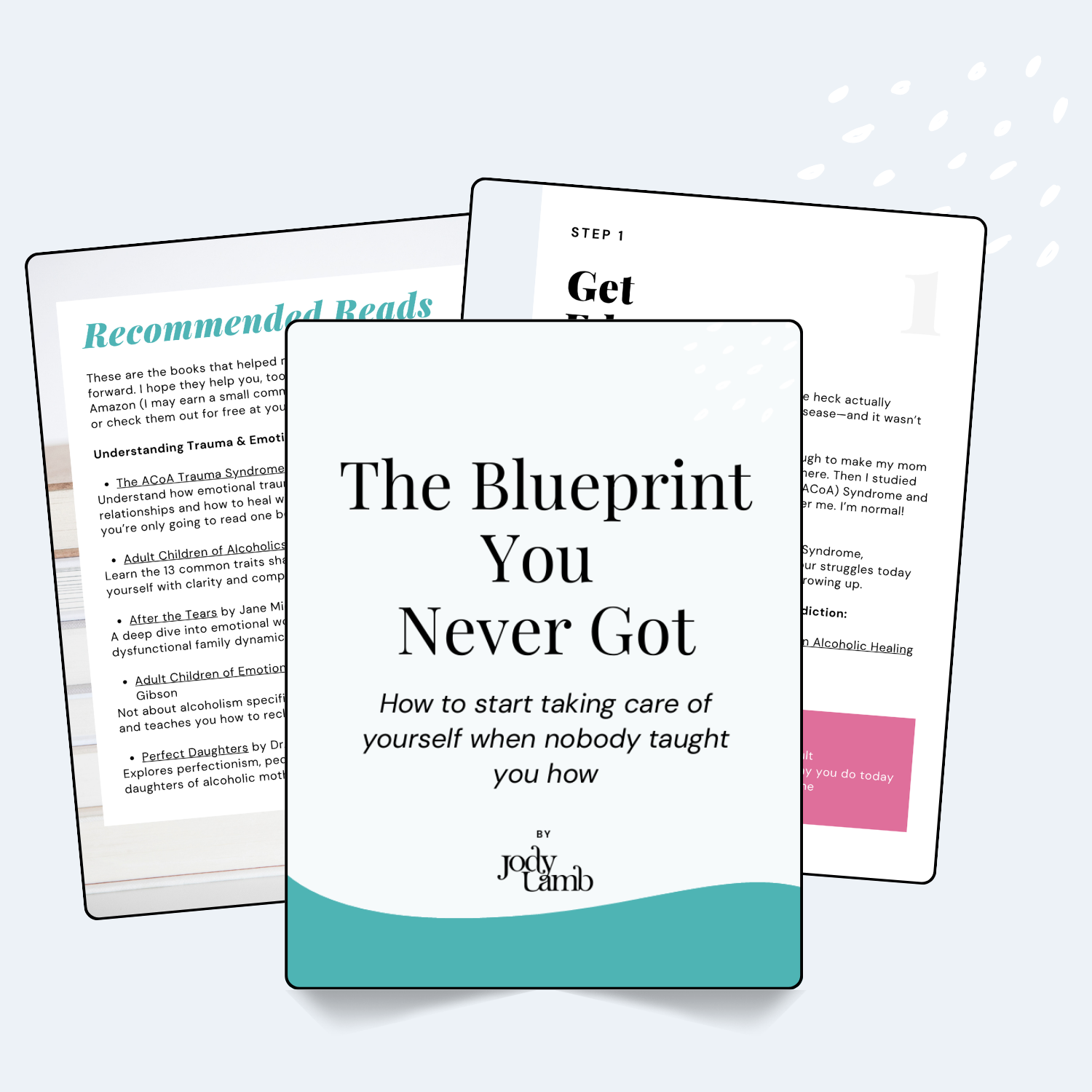
Take charge of your healing with the free The Blueprint You Never Got. The short, practical first steps to taking care of yourself when nobody ever taught you how – from someone who had to figure it out from scratch.
It’s gentle, grounding, and filled with practical steps to help you begin healing from the effects of growing up with an alcoholic parent.
You are not alone.
You are not broken.
And you are absolutely capable of creating a life that feels calm, connected, and joyful.
And if you prefer learning through video, I’ve also recorded a full breakdown of these seven hidden patterns — what causes them, how they show up, and how to start unlearning them.
🎥 Watch the related video: