
Why Am I Always in Survival Mode?
You’re always in survival mode because you learned to survive a childhood that didn’t feel safe and no one ever told your body the danger had passed. If you grew up around addiction, chaos, or emotional absence, staying alert, staying small, and handling everything yourself kept you okay back then. The problem is that those survival skills don’t switch off on their own. Your nervous system keeps running the same program long after the threat is gone, so you stay braced, exhausted, and wired for a crisis that isn’t happening anymore.
I’m Jody Lamb, author and memoirist, and I was stuck in survival mode from the time I was about twelve years old. I just didn’t have a name for it. I thought that low hum of dread was simply what being alive felt like.
I go deeper on this in the video.
What does survival mode actually feel like?
It rarely looks like panic. More often it looks like a competent, tired person who can’t figure out why everything takes so much out of them. Here are the signs I lived with for years without recognizing them:
- You can’t relax. You sit down to rest and immediately feel guilty, anxious, or like you’re forgetting something. Rest doesn’t feel safe; it feels dangerous.
- You’re always braced for the worst. You run worst-case scenarios on a loop, not because you’re negative, but because anticipating the bad thing once kept you from being blindsided.
- You don’t know what you actually want. Someone asks what you want for dinner, or what you want your life to look like, and you go blank. Your wants got filed away as irrelevant a long time ago.
- You feel guilty for having needs. Asking for help feels weak. Needing rest feels lazy. So you handle everything yourself and take up as little space as possible.
- You’re exhausted but you can’t stop. Bone-deep tired, running on adrenaline and willpower instead of actual energy and terrified of what happens if you slow down.
- You over-function in relationships. You’re the fixer, the peacekeeper, the one everyone brings their problems to. You take care of everyone beautifully. But who takes care of you?
- You feel like you’re performing your life instead of living it. You look fine on the outside, but inside you’re watching from behind glass, going through the motions.
If your nervous system can’t tell the difference between rest and danger, you’re not lazy; you’re still surviving.
If you recognized yourself in even a few of those, I want to be clear: that’s not weakness. Every one of those patterns is something you built to get through something real.
Why does this happen when you grew up around dysfunction?
Because survival mode was the correct response to your childhood. It only became a problem when the childhood ended and the wiring stayed.
My survival mode started around middle school, when my mom’s alcoholism got really bad. I was constantly worried, constantly scanning, trying to predict what was going to happen next. I couldn’t focus on school or friends because I was too busy holding things together. By my teens and twenties, it had escalated. I’d become a second (perhaps primary?) parent to my little sister, taking care of her and the house and the chaos while pretending everything was fine. The whole story is in my memoir.
Every single day was just about getting through it. I wasn’t dreaming about the future or thinking about what I wanted. I had no real hope that things would be different. I was just surviving, day after day.
I didn’t know I was in survival mode. I thought that was just life; I thought everyone felt that way.
It took me years to even realize I’d been surviving since I was at least twelve. And once you can name it, you can finally start to change it.
Why can’t I just stop, even though I’m exhausted?
Because this was never about discipline, and it won’t be fixed by trying harder. If you’re exhausted but can’t rest, that’s not a willpower problem; it’s dysregulation. Your system doesn’t feel safe enough to stand down, so it keeps you moving even when there’s nothing left in the tank.
Over-functioning is a huge part of this, and it’s where survival mode quietly costs you the most. When you’re the strong one, the responsible one, the one who never falls apart, you pour all your care outward and receive almost none of it back. You can spend an entire life managing everyone else’s needs and never once tend to your own.
That’s exactly why I keep coming back to one idea: your primary job in life is to take good care of yourself, not other people. Not because you stop loving the people you love, but because you cannot heal a nervous system that’s still convinced its only job is to keep everyone else safe.
If this is landing, the blueprint I made walks you through the first steps:
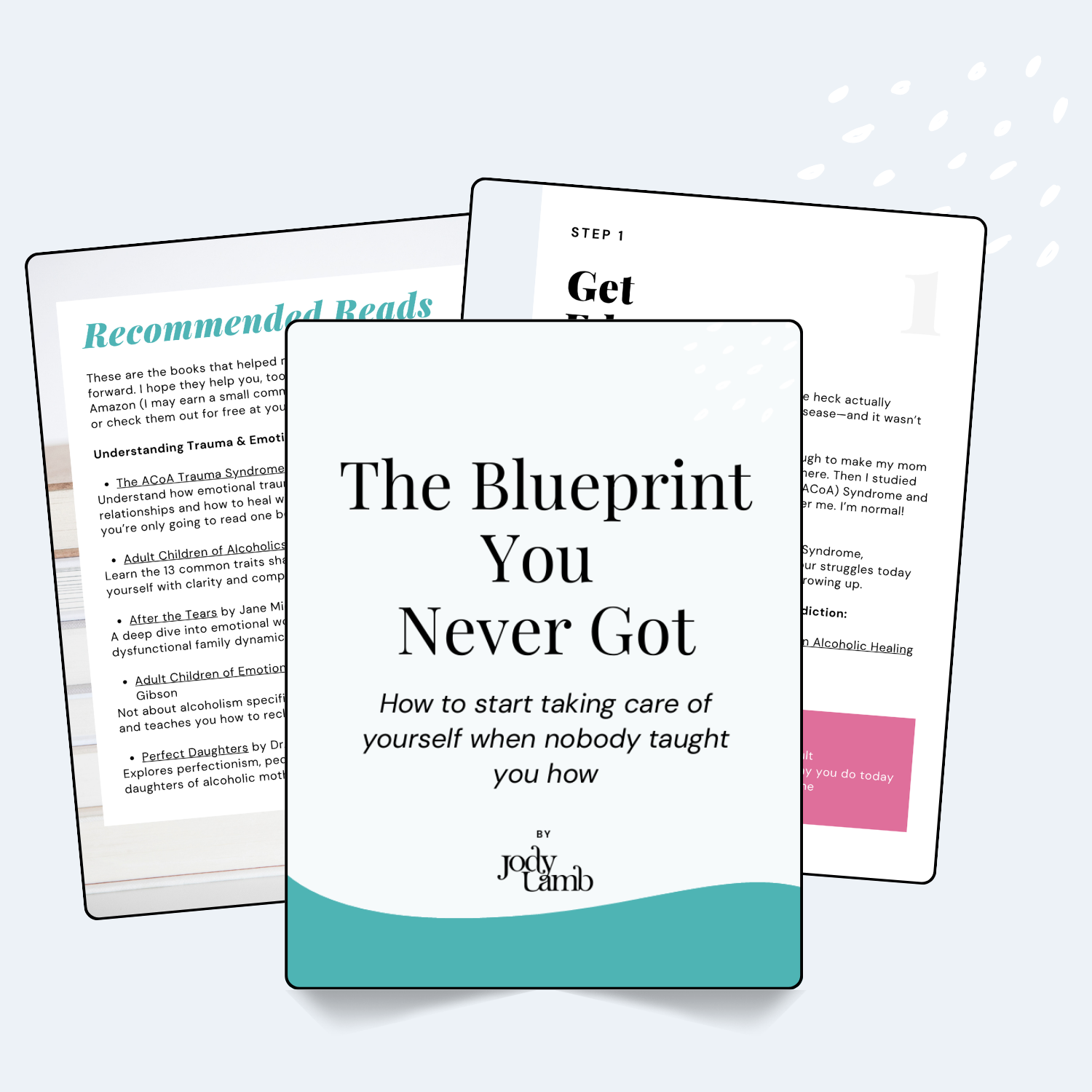
You spent years taking care of everyone else. The Blueprint You Never Got is the free guide to finally taking care of you — the thing nobody ever taught you how to do.
Can you actually get out of survival mode?
Yes. Not fast, and not in a straight line but yes. I know because I’ve done it, and I’m still doing it.
Getting out isn’t about forcing yourself to relax. It’s about slowly teaching your nervous system that you’re safe now, one small piece of evidence at a time. That looks like resting once without earning it first. Answering “what do I actually want?” for something tiny, like dinner, and letting the answer count. Letting one person help you with one thing. Noticing when you’re bracing for a shoe that’s never going to drop.
Survival mode got you through. It was never meant to be where you live.
Each of those small moments tells your body the truth it never got to hear: the emergency is over. You made it. It’s safe to put some of this weight down.
You’ve survived so much already. The work now is different. It’s learning to actually live. If you’re not sure where to begin, I made you a free guide, The Blueprint You Never Got, that walks you through the first steps of teaching yourself the safety and self-care nobody taught you. It’s the roadmap I wish someone had handed me. Grab it below.
You spent years taking care of everyone else. The Blueprint You Never Got is the free guide to finally taking care of you — the thing nobody ever taught you how to do.
Frequently Asked Questions
Is survival mode the same as anxiety? They overlap, but they’re not identical. Anxiety is one feature of survival mode; survival mode is the broader nervous-system state that also drives over-functioning, difficulty resting, numbness, and disconnection from what you want. You can be in survival mode and look calm on the outside.
Can you be in survival mode without knowing it? Absolutely! This is the most common way it shows up. If it started in childhood, it doesn’t feel like a state you’re in; it feels like your personality, or just “how life is.” I didn’t realize I’d been surviving since age twelve until years into adulthood. Naming it is usually the first real step out.
How long does it take to get out of survival mode? There’s no fixed timeline, and it isn’t linear. Healing a nervous system happens gradually, through repeated small experiences of safety, rest, and having your needs met. Progress tends to come in small shifts you feel before you can measure and those shifts are what make it worth continuing.