
Why Do I Feel Guilty Doing Nothing?
You feel guilty doing nothing because rest guilt isn’t a personality quirk or a sign you’re “type A” — it’s a survival response. If you grew up in an unpredictable home, your nervous system learned early that stillness was dangerous, because a quiet house was often just the calm before the storm. So staying busy became how you stayed safe. Underneath it runs a belief you probably never chose: that your worth comes from what you do for other people. That’s why sitting still doesn’t just feel unproductive — it feels wrong, almost unsafe.
I’m Jody Lamb, author and memoirist, and my rest guilt ran so deep that I used to put “relax” on my to-do list, so that doing it would feel like an accomplishment instead of a failure. I grew up with a mom who struggled with alcoholism, and I spent most of my life unable to sit still.
I go deeper on this in the video.
Why does doing nothing make me feel guilty?
Because your body is still running a program it wrote a long time ago. When you grow up in a home where things are unpredictable — a parent’s drinking, emotional chaos, financial stress, whatever your version was — your nervous system learns that stillness is a threat. When things went quiet in your house, that usually meant something bad was about to happen. So your body made a rule: stay alert, stay busy, keep moving. If you’re moving, you’re in control. If you rest, something might fall apart.
Fast-forward to adulthood, and you’re a fully functioning grown-up with a safe home and a stable life — and your body is still running that old program. Sitting on the couch on a free Saturday feels dangerous because your nervous system never got the memo that you’re safe now.
Rest guilt isn’t a personality flaw or being “too type A.” It’s a survival response; your nervous system running old software.
I remember the first time a therapist told me I needed to practice resting. I said, “Practice? You just sit there.” She said, “For you, that’s going to be the hardest thing I ask you to do.” She was right. I’d try to rest and within five minutes I was reorganizing a closet or cleaning something that didn’t need cleaning. My body could not tolerate the stillness.
What’s the belief underneath the guilt?
The guilt about resting isn’t really about rest. It’s about a belief, and it usually sounds like this: my worth comes from what I do for other people. If I’m not being productive, I’m not earning my right to exist. If I rest, I’m selfish. If I stop, everything falls apart.
Sound familiar? If you grew up being the responsible one — the kid who held the family together, managed everyone’s emotions, made sure things didn’t collapse — you learned very early that your value was in your usefulness. You were the good kid because you were the helpful kid. You were loved because you were needed. And that hardens into a belief system that runs your whole adult life: I must be useful to deserve rest. I must earn the right to stop.
That survival strategy worked when you were twelve. It’s quietly destroying you at thirty-five — or forty-five, or fifty-five.
That’s not a personality trait. It’s a strategy you built to survive, and it did its job. It’s just costing you far too much now.
If what I’m describing sounds like your life — the guilt, the belief that your worth is your usefulness — I wrote a free guide that walks through the first steps of changing that pattern. Link below.
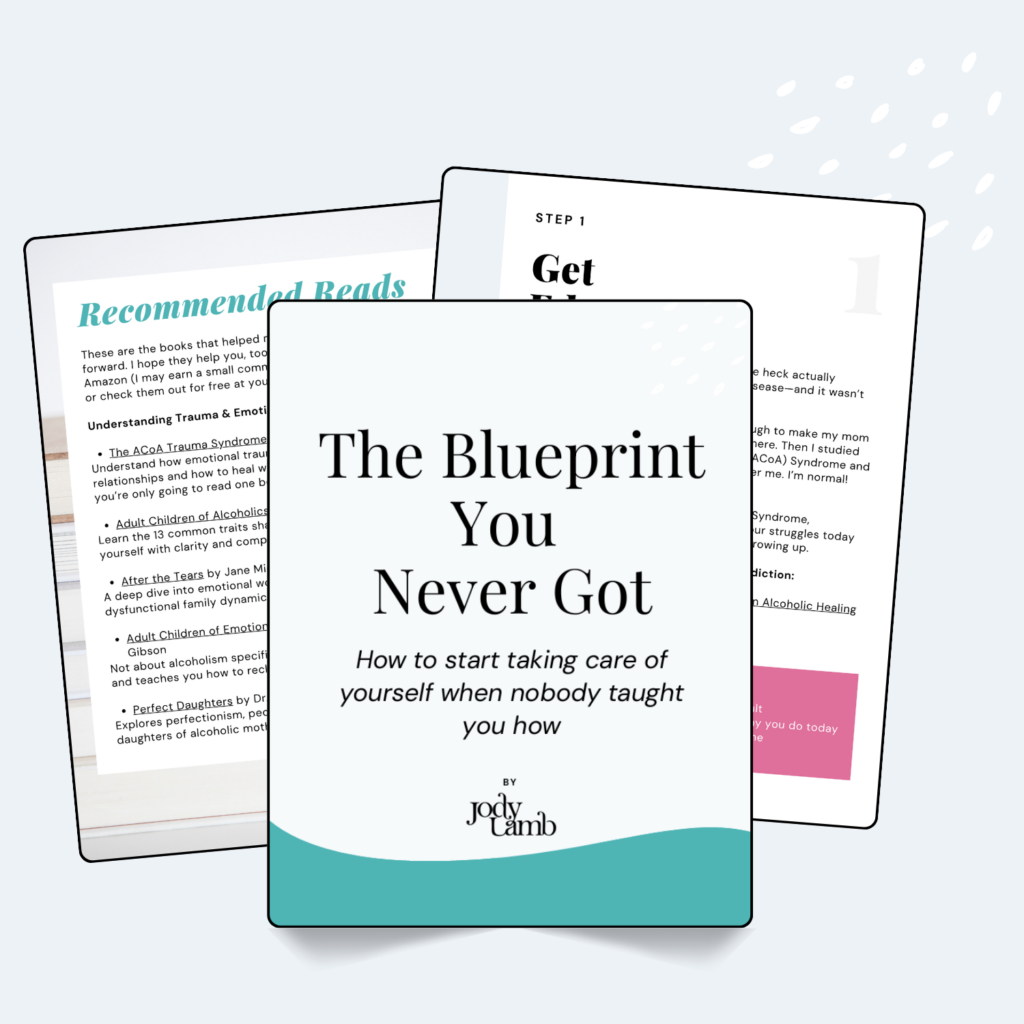
You spent years taking care of everyone else. The Blueprint You Never Got is the free guide to finally taking care of you — the thing nobody ever taught you how to do.
How do I rest without the guilt spiral?
I’ll be honest: there’s no single trick that undoes a lifetime of rest guilt. But four things genuinely helped me, and I think they’ll help you too.
- Name the voice. When you’re on the couch and the guilt starts — you should be doing something — pause and say, out loud if you need to: “That’s the old program. I’m safe. I’m allowed to rest.” It feels weird at first, but naming it strips its power. You’re not lazy. Your nervous system is just running old software.
- Start with tiny, time-bound rest. Don’t try to take a whole day off; your body won’t allow it yet. Start with fifteen minutes. Set a timer. Sit down, no phone, no to-do list, and just be there. When the guilt shows up (it will), name it, let it be there, and don’t get up. Fifteen minutes. That’s the practice, and it gets easier.
- Redefine what rest is. Rest doesn’t have to mean sitting perfectly still, which can feel impossible for people like us at first. It can be a walk with no destination, reading something “unproductive,” music, cooking just because, lying in the grass. The only rule: it’s not for anyone else and it’s not useful. It’s just for you.
- Separate your worth from your productivity. This is the real work, and it takes longer than one blog post. But here’s the seed: you are not valuable because you’re useful. You are valuable because you exist. You were born deserving rest — you don’t have to earn it.
You are not valuable because you’re useful. You are valuable because you exist. You were born deserving rest.
What do I do with the belief that I have to earn rest?
You start letting a new truth sit next to the old one — even before you believe it. Here’s the thing I wish someone had told me twenty years ago: your primary job in life is to take good care of yourself, not other people. Not to be useful. Not to hold everything together. Not to earn your right to exist by never sitting down.
Your job is to rest. To enjoy your life. To take care of yourself the way you’ve spent years taking care of everyone else. That might feel radical right now, even wrong. That’s okay — you don’t have to believe it yet. You just have to hear it, and let it start to loosen the old rule. This is the whole heart of my memoir, My Job Is Me, because learning that my job was me — not endless usefulness — is what finally let me sit down.
You didn’t get taught any of this, so I made you a place to start. The Blueprint You Never Got is a free guide with the first steps for taking care of yourself when nobody ever showed you how. Grab it below — and then, if you can, sit down for fifteen minutes today and let that be enough. It is.
You spent years taking care of everyone else. The Blueprint You Never Got is the free guide to finally taking care of you — the thing nobody ever taught you how to do.
Frequently Asked Questions
Why do I feel anxious or guilty the moment I try to relax? Because if you grew up in an unpredictable home, your nervous system learned that stillness signaled danger — the calm before something went wrong. So rest trips the old alarm, and guilt or anxiety rushes in to get you moving again. It’s a survival response, not laziness, and it can be unlearned with practice.
How do I actually stop feeling guilty for resting? Start small and specific: name the guilt as old programming (“that’s the old program, I’m safe”), practice tiny time-bound rest like fifteen phone-free minutes, redefine rest as anything that’s just for you, and slowly work on separating your worth from your productivity. The guilt fades as your body collects evidence that resting is safe.
Is rest guilt a sign of something deeper? Often, yes. It usually points to a belief that your worth is tied to your usefulness — common in people who were the “responsible one” in a difficult home. That’s a learned belief, not a fact about you, and it can be gently unwound over time, sometimes with the help of a therapist or support group.