
Why Doesn’t Self-Help Work for Me?
Self-help doesn’t work for you because most of it wasn’t written for people like us. It assumes you’re starting from a baseline of “normal” — that you already know how to rest, set a boundary, name what you need, and love yourself — and then asks you to optimize from there. But if you grew up in dysfunction, you may have never gotten that foundation, so the advice skips the exact step you need most. The fact that it didn’t work isn’t proof you’re broken. It’s proof you needed something built for a different starting point.
I’m Jody Lamb, author and memoirist, and I’m a world-class consumer of self-help — dozens of books, journals, morning routines – the stuff promoted to the masses. Almost none of it worked, and I spent years feeling like a failure for it. I grew up as the daughter of an alcoholic mother, and here’s what I finally understood about why general self-help content didn’t help me:
I go deeper on this in the video.
Reason 1: It assumes you already have a baseline
Most self-help assumes you’re starting from “normal.” It assumes you already know how to rest, how to set a boundary, how to identify what you need, how to ask for help and it asks you to fine-tune from there. But what if you never had the baseline? What if no one taught you what rest looks like, and you’ve never set a boundary because you grew up where your boundaries didn’t exist?
I once read a book that told me to “tune into what my body needs,” and I sat there completely baffled. I’d spent my entire childhood tuning into what my mom needed, what the house needed, what everyone else needed. My own body? I had no idea what it needed. I didn’t even know it was allowed to need things.
That’s not a personal failing. It’s a starting point most self-help doesn’t acknowledge exists. Those books are written for people who need a tune-up. We need the entire owner’s manual.
Reason 2: It tells you to love yourself without asking why you don’t
Self-help loves to tell you to love yourself, affirm yourself, be kind to yourself — and it almost never asks the actual question: why don’t you? Because the answer is uncomfortable. You don’t struggle to love yourself because you forgot or didn’t try hard enough. You struggle because you were taught, through years of your needs coming last, that you’re not the priority — that your value is measured by what you do for others.
You can’t affirmation your way out of a lifetime of being taught you don’t matter. It’s like putting a bumper sticker on a car with no engine.
What I actually needed early in my healing wasn’t another affirmation. I needed someone to explain where that belief came from — that my inability to love myself wasn’t a character flaw, but a direct result of growing up in a home where my worth was tied to my usefulness. Once I understood the origin, I could start to question it. Most self-help skips right over this and jumps to the solution without naming the problem. But for people like us, naming the problem is the solution.
If any of this is landing and you want a starting point that actually acknowledges where you’re coming from, I made one — link below.
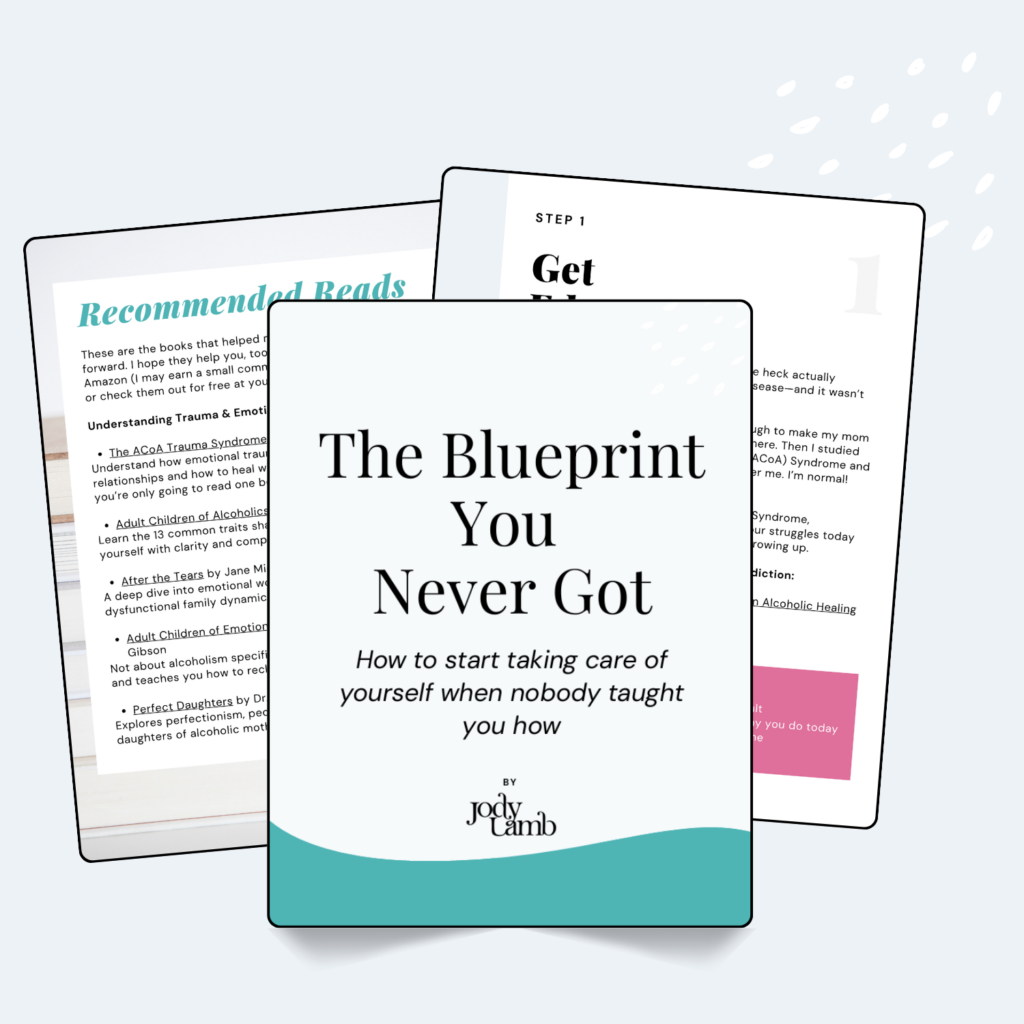
You spent years taking care of everyone else. The Blueprint You Never Got is the free guide to finally taking care of you — the thing nobody ever taught you how to do.
Reason 3: It treats your survival skills as the problem
This is the one that used to make me angry at the whole personal-growth world. Self-help looks at the things that kept you alive in a chaotic home and calls them problems to fix. You’re a people-pleaser? Stop it. You can’t set boundaries? Just set them. You’re a perfectionist, you over-function, you can’t say no? Problem, problem, problem.
But nobody stops to say: those aren’t problems. Those are survival skills. People-pleasing kept the peace. Perfectionism made you invisible to criticism. Over-functioning meant things got done when no adult was reliable. Not saying no meant you didn’t get punished. Those strategies saved you. And then self-help walks in and says “just stop,” as if they’re bad habits instead of deeply wired survival responses.
Your survival skills aren’t character flaws. They’re evidence of how strong you were as a kid.
The day I stopped seeing my patterns as flaws and started seeing them as proof of how well I survived — that’s the day I stopped feeling broken. I wasn’t broken. I was brilliant. I’d survived something most adults would struggle with, and I did it as a child. From that place of respect for my own survival, I could finally build new ways of being — not because the old ones were shameful, but because I was safe now and I deserved better ones.
Reason 4: It never tells you what your actual job is
Here’s the big one. Most self-help hands you a hundred things to do — meditate, journal, set goals, drink water, wake up early, practice gratitude. All fine. But none of it answers the question people like us are actually asking: what is my job here?
Because we had a job. Since childhood, our assignment was clear: take care of everyone else, manage the chaos, hold the family together, be useful, be needed. We’ve been working that job for decades. And then self-help says “take care of yourself” as item seven of fifty, sandwiched between “start a morning routine” and “practice visualization,” as if it’s equal to drinking eight glasses of water.
For people like us, “take care of yourself” isn’t a tip. It’s a complete rewrite of your job description.
Here’s what no general self-help book ever told me, and what I need to tell you: your primary job in life is to take good care of yourself — not other people, not the family, not the chaos. You. That’s the assignment you were always supposed to get, and nobody ever handed it to you. Instead you got someone else’s job description, and you’ve worked it so long it feels like yours. It’s not. It never was. And realizing that isn’t step seven of twelve — for us, it’s the entire point.
So what actually works instead?
What works is the opposite of what most self-help offers: someone to name where your patterns came from so you can stop blaming yourself for having them, someone to tell you your survival skills were strengths and not defects, and someone to look you in the eye and say your real job is to take care of yourself — then help you start from the actual beginning, not from a baseline you never had.
That means going gentler and earlier than the books assume. Understand the origin before you try to override the belief. Honor the pattern before you try to change it. Treat learning self-care like learning a language from scratch, not optimizing one you already speak. It’s slower than “12 steps to a new you,” but it’s real, and it holds.
You didn’t need to try harder — you needed something built for you. The Blueprint You Never Got is a free guide I made for exactly this gap: a practical starting point for people who were never taught how to take care of themselves. I built it because I spent years looking for self-help that understood my starting point and couldn’t find it. Grab it below — and go easy on yourself. It was never you.
You spent years taking care of everyone else. The Blueprint You Never Got is the free guide to finally taking care of you — the thing nobody ever taught you how to do.
Frequently Asked Questions
Why doesn’t self-help work for me even though I try so hard? Because most self-help assumes a baseline you may never have gotten — that you already know how to rest, set boundaries, and value yourself — and then asks you to optimize from there. If you grew up in dysfunction, that foundation is exactly what’s missing, so the advice skips your real starting point. It’s not a willpower problem. You need the owner’s manual, not a tune-up.
Is self-help useless if I grew up in a dysfunctional home? No, but you likely need to start earlier than most books begin. Before “optimize your routine,” you need to understand where your patterns came from and build a foundation of basic self-care and safety. Once you’ve named the origin of your beliefs and honored your survival skills, a lot of standard advice starts to actually stick.
What kind of self-help actually works for people who grew up in dysfunction? Approaches that name where your patterns came from, treat your survival skills as strengths rather than flaws, and frame taking care of yourself as the whole point rather than one tip among fifty. For many people that means trauma-informed therapy or a community like Al-Anon or ACA, alongside resources written specifically for adult children of dysfunction.