How Do I Find Hobbies I Actually Enjoy as an Adult?
You find hobbies you actually enjoy by starting from the version of you that existed before life got heavy: ask what you loved as a kid, experiment with tiny zero-stakes tries, and choose things because they delight you rather than because they’re useful. If you grew up in a dysfunctional home, the hard part usually isn’t the hobbies themselves; it’s that you were never given room to play, so the signal for what you like went quiet. The good news is it isn’t gone. You can turn the volume back up.
I’m Jody Lamb, author and memoirist, and for years I couldn’t have answered this question. Someone once asked me what I do for fun, and I just stared at them. I had nothing because somewhere between managing my mother’s drinking and making sure nobody fell apart, I’d forgotten how to play.
I go deeper on this in the video.
Why is it so hard to know what I even enjoy?
Because when you grow up in an unpredictable home, your brain learns one thing fast: be useful, be invisible, or be ready. That’s survival mode, and it doesn’t leave much room for finger painting. Play was often one of the first things taken from you because there simply wasn’t time or safety for it.
So over time you just stop knowing what you like. It’s not dramatic; the signal goes quiet. Someone asks about your hobbies and you genuinely don’t have an answer, or you name things that feel productive — reading self-help, organizing the house — because deep down you learned that your worth comes from being useful. And there’s usually a harsh inner voice in the mix, too, the one that says that’s a waste of time, you’re too old for that, who do you think you are?
That harsh inner voice telling you a hobby is a waste of time isn’t yours. It’s just what survival mode sounds like once you’ve grown up.
That voice kept you safe as a kid by keeping you small. But you’re not a kid anymore, and you’re allowed to turn it down.
What are the steps to find hobbies you actually love?
Here’s the five-step path that took me from “I don’t know what I like” to having a life full of things I love:
- Give yourself the permission slip. If you grew up where your needs didn’t matter, you may need to actually hear this: you’re allowed to do things just because they’re fun, allowed to be bad at them, allowed to enjoy being alive without earning it first.
- Go back to the kid. Ask what you loved before you learned to be the responsible one. When I started healing, I found my childhood diaries and read them — and met a little girl who lived to read and write. Those parts of me hadn’t died. They’d just gone underground.
- Experiment with zero stakes. Your first attempt at anything doesn’t count. The goal isn’t to be good; it’s to feel something. For me that meant a creative writing class at the community college, a library card and aimless browsing, and walks with no step count attached.
- Choose delight over performance. Stop asking “is this productive?” and start asking “does this make me feel alive?” (More on this below — it’s the one that changed everything.)
- Protect it. The old programming will try to reclaim your joy: you should be cleaning, this is selfish, see, you’re bad at it. Expect that voice, and do the thing anyway. Every time you choose joy over guilt, you rewire the story.
Why does choosing delight over usefulness matter so much?
Because when you grow up in dysfunction, you learn that everything has to have a purpose. Rest has to be “recovery.” Reading has to be “self-improvement.” Even hobbies have to look good on paper. So the radical shift is learning — really learning, not just reading about it — that play is not a reward for being productive. It’s a basic human need that was stolen from you.
Play isn’t a luxury you earn. For people like us, choosing it is a radical act of reclamation. We’re taking back the part of childhood we missed.
This is where your primary job in life quietly becomes taking good care of yourself, not everyone else. Choosing something with no outcome, no audience, and no metric for success is one of the most healing things you’ll ever do. For me, it was the moment writing stopped being about whether it was “good enough” and the walks stopped being exercise and started being peace. It didn’t change my life in a dramatic montage. It changed it on a quiet Tuesday afternoon, and it mattered more than I can tell you.
If this is landing, the blueprint I made walks you through the first steps of giving yourself that permission:
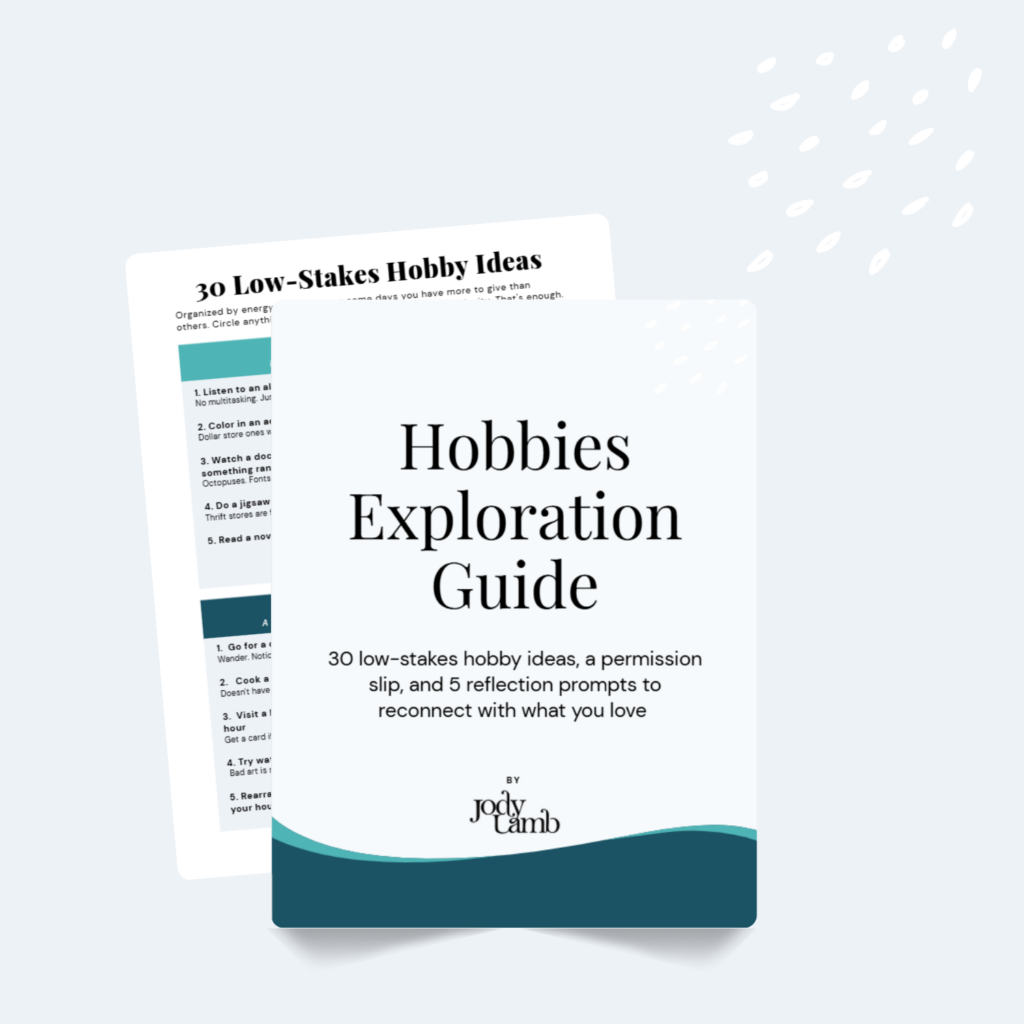
30 low-stakes hobby ideas organized by energy level, a printable permission slip, and 5 reflection prompts in this Hobby Exploration Starter Kit to reconnect with what you actually enjoy.
Where can rediscovering play actually lead?
Somewhere you can’t predict from where you’re standing now. I want you to see the full picture, because these small, low-stakes experiments can turn into a life you didn’t know was possible.
That creative writing class led me to write regularly again, just for myself. The writing became a book for tweens. Sharing my story led me to a whole community of adult children of alcoholics who finally made me feel like I belonged somewhere, after a lifetime of not. I started volunteering with kids at an addiction treatment facility, taking what I lived through and using it to help a child feel less alone. I joined writers’ groups and made real friends. And all of it started with a box of old journals and one question: what did I used to love?
You’re not broken. You just didn’t get the blueprint for this so I made you one. The Blueprint You Never Got is a free guide that walks you through taking care of yourself and building a life you enjoy when nobody ever taught you how. It’s the roadmap I wish I’d had. Grab it below, and then go do something fun today. You’re allowed.
30 low-stakes hobby ideas organized by energy level, a printable permission slip, and 5 reflection prompts in this Hobby Exploration Starter Kit to reconnect with what you actually enjoy.
Frequently Asked Questions
Why can’t I figure out what I like to do? Because in survival mode your job was to be useful and read the room, not to have preferences so the signal for what you enjoy went quiet from disuse. It isn’t gone. Asking what seven-year-old you loved, and trying small low-stakes experiments, gradually brings it back online.
Is it normal to feel guilty for spending time on a hobby? Yes, especially if you grew up in a home where rest and play weren’t modeled. That guilt is old programming, not truth. It tends to loosen each time you choose the hobby anyway and prove to yourself that enjoying your life doesn’t have to be earned.
What are good low-stakes hobbies to start with? Anything small, cheap, and pressure-free: a library card and aimless browsing, a walk with no step goal, a twenty-dollar LEGO set on a Saturday, a beginner class you take just to see how it feels. The point isn’t the specific hobby — it’s keeping the stakes low and noticing what lights up inside you.