The Moment I Stopped Trying to Save My Alcoholic Mom
For more than twenty years, I tried with everything I had to convince my mom to stop drinking — to cure her alcoholism and make us all live happily ever after. The moment I finally stopped came on an ordinary morning drive to work, when I realized that if I didn’t start taking care of myself, I wasn’t going to survive. What I understand now, and what took me two decades and a breakdown by a lake to learn, is this: you cannot save someone who has to save themselves, and that your primary job in life is to take good care of you.
I’m Jody Lamb, author and memoirist. I grew up as the firstborn daughter of an alcoholic mother, and I want to tell you about the exact moment everything changed because if you’re standing where I stood, exhausted from trying to fix someone you love, I think you need to hear it.
I go deeper on this in the video.
What made me think I could save my mom?
I spent my childhood and young adult years completely convinced it was my duty to help my mother. I loved her deeply, and I believed that as the firstborn daughter, it was my job to find the solution — the right combination of words, the breakthrough letter slipped under her door — that would finally open her eyes and get her to stop.
I didn’t understand the science of addiction. I didn’t understand what she was going through or what was happening to our family. All I knew was that my mom drank too much, things spun out of control, and I was constantly worried sick. So I appointed myself the fixer. By the time I was 26, I was fully exhausted. I had no real life. I just worked all the time, took care of my little sister, and tried to hold everything together — full-on survival mode, just get through and survive every single day.
I felt like I’d been handed a life sentence for an impossible job: fix Mom. And I felt like a failure because I couldn’t do a job that was never mine to do.
What was the moment I finally stopped?
One morning I was driving to the office, on a route that curved around a beautiful lake. It was usually serene — the sun rising, the light glistening on the water — and I always reminded myself to pause and notice the beauty of it.
But that particular morning, I felt so deeply depressed that I didn’t want to face the day. I didn’t want to face any day. Every day had become the same day, Groundhog Day on a loop, and I was exhausted on every level — physically, mentally, all of it. And then a feeling came over me that I had never felt before: the stark realization that if I didn’t do something to change my life and focus on myself, I wasn’t going to make it. I had become so ill from all of it that some part of me knew I was running out of time.
I had to pull over. I sat there and cried, then wiped my makeup, gathered myself for ten or fifteen minutes, and eventually drove on to work. And underneath the fear, there was something else I didn’t expect: relief. I had finally set down a piece of the burden. I had finally accepted that I couldn’t fix my mom.
Why couldn’t I save her? The glass room.
Here’s the image I’ve come back to for years to explain what loving her felt like. Imagine standing outside a glass room. Inside, your loved one is staggering around while a fire rages, narrowly missing the flames, unable to find their way. You’re on the outside, pounding on the glass, pleading with them to get out — but only they can turn the doorknob. You can’t get in. You can’t turn it for them.
And the cruelest part: the longer you stand there pounding on the glass, breathing that smoke and that unhealthy air, the sicker you become. That’s exactly what happened to me. I know some people might think that sounds dramatic — but anyone who has loved someone with a substance use disorder knows how painful it is to witness, how helpless and out of control it makes you feel.
Loving an addict is like pounding on the glass of a burning room. Only they can open the door — and the longer you stand there, you breathe the smoke and get sick too.
If you’re standing outside that glass right now, exhausted and ill from the smoke, I made a free guide for the moment you’re in — link below.
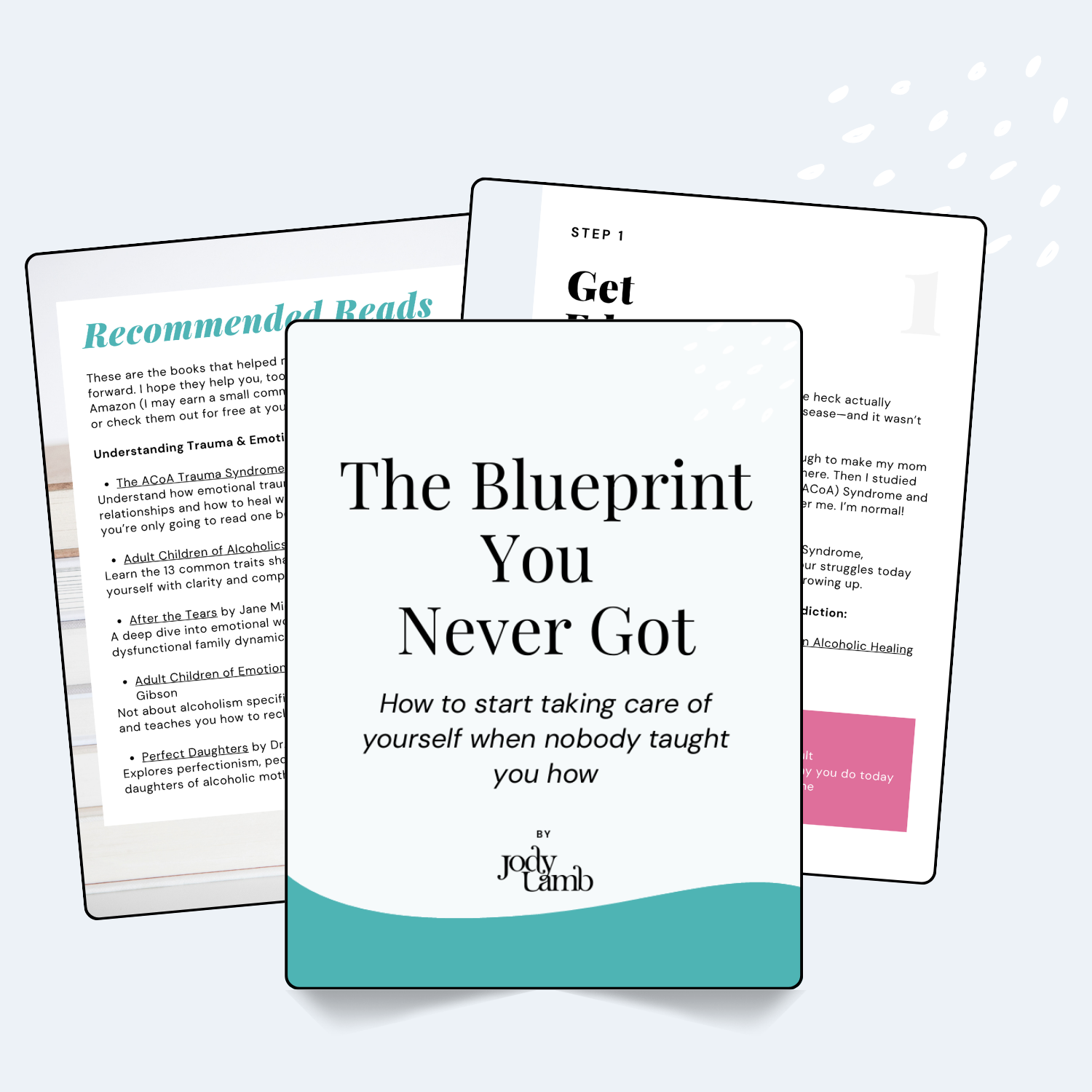
You spent years taking care of everyone else. The Blueprint You Never Got is the free guide to finally taking care of you — the thing nobody ever taught you how to do.
What did I do instead?
Out of pure desperation, I started focusing on myself — and I want to be specific about what that actually looked like, because “focus on yourself” can sound vague when you’re drowning.
I went to Al-Anon support group meetings. I got into therapy with a therapist who had real expertise in adult children of alcoholics and dysfunctional families. I started learning what I actually loved to do, and then doing it. And I took tiny self-care steps — figuring out, almost from scratch, what it even means to take good care of yourself. Over time, those small things added up to real progress. Nearly twenty years later, I have a life I couldn’t have imagined on that terrifying morning by the lake.
And here’s what surprised me most: once I got the education to understand addiction, I realized you cannot control or cure another person — only they can accept help when they’re ready. All those years, I’d been on an impossible quest without knowing it. Letting go of it didn’t make me a worse daughter or sister. The opposite happened.
I couldn’t be the best sister or daughter while I was falling apart inside. I had to save myself first — and in turn, my whole family actually improved.
What I know now: my job was always me
That drive was the turning point, and everything since has confirmed what I discovered: my real job in life — my first job, my primary job — is to take good care of myself. Not my mother, not my father, not even my sister. Because I couldn’t be good for any of them while I was this unwell. I had to save myself.
Your primary job in life is to take good care of yourself, not other people. And when you actually hold that as your job description, day-to-day decisions get so much clearer. You can look at everything through one lens: is this the right thing for me? Am I getting my basic needs met — sleep, nutrition, movement? Am I healing, getting educated, finding support — the meetings, the therapy, the friends who want to see me get well? That’s the work, and it’s the most important work there is.
If you’re in a dark spot right now, overwhelmed and unsure how you’ll ever get out of the role of trying to save your loved one, please start with the basics: support, therapy, sleep, your body’s basic needs. I’m living proof it’s possible, and so are the hundreds of people I’ve connected with over the years. There are millions of us who grew up with an alcoholic parent, learned to take good care of ourselves, and built a very different, much better life. You are not alone.
This is the whole story I tell in my memoir, My Job Is Me, my life coping with my mother’s alcoholism, and how I finally realized what my true job was and rebuilt everything from there.
The Blueprint You Never Got is my free guide with the first steps for learning to take good care of yourself when you never got the healthy modeling for it. Grab it below.
You spent years taking care of everyone else. The Blueprint You Never Got is the free guide to finally taking care of you — the thing nobody ever taught you how to do.
If you’re in a genuinely dark place right now, please don’t carry it alone — a therapist, your doctor, or a support community like Al-Anon can help, and reaching out is a real act of taking care of yourself.
Frequently Asked Questions
How do you know when to stop trying to save an alcoholic parent? There’s rarely a clean signpost, but for many people it comes when the cost to their own health and life becomes impossible to ignore — the exhaustion, the depression, the sense of just surviving each day. Understanding that you cannot control or cure another person’s addiction, and that only they can choose recovery, is what makes it possible to let go. Stopping isn’t giving up on them; it’s refusing to go down with them.
Is it selfish to focus on yourself instead of your addicted parent? No. You cannot help anyone well while you’re falling apart, and destroying your own health won’t cure their addiction — it only means two people are suffering instead of one. Taking care of yourself often makes you a better sibling, child, and friend. In my case, focusing on my own healing is what allowed my whole family to improve.
What actually helps after you stop trying to fix an alcoholic loved one? The basics, done consistently: a support group like Al-Anon, therapy (ideally with someone who understands adult children of alcoholics), and small, steady self-care — sleep, nutrition, movement, and slowly rediscovering what you enjoy. It’s not fast or dramatic, but over time it rebuilds a life. Millions of people who grew up with addiction have done exactly this and live very differently than they once imagined.