
How Do I Overcome My Relationship Trust Issues from Childhood?
You overcome trust issues from childhood that affect your romantic relationships by treating them as a symptom, not a character flaw and then working the three things underneath them. First, you heal yourself enough to feel safe in your own body, because you can’t love well from survival mode. Second, you learn your boundaries and hold them, which teaches you to trust yourself. Third, you say the hard thing out loud, in real time, so the old patterns lose their grip. And the deepest layer: you rebuild the belief that you’re worth staying for.
I’m Jody Lamb, author and memoirist, and I went fifteen years without a single long-term relationship — walled off, certain love wasn’t safe — before I got married a few years ago. I grew up with an alcoholic mother, and that experience deeply affected me and caused trust issues. This is what actually changed things and helped me overcome them:
I go deeper on this in the video.
What do childhood trust issues actually look like?
Not always the obvious way. Most people picture jealousy or snooping through a phone. But when you grew up around addiction, trust issues tend to show up sneakier than that. See if any of these sound familiar:
- The wall. You’re with someone kind and consistent, and instead of happy, you feel nothing or uncomfortable. They say something sweet and you deflect or make a joke. There’s a glass wall between you and closeness, and you don’t even remember building it.
- The test. You pick a fight or pull away, not because you’re mean, but because you need to know: if I show you the worst of me, will you stay? And if they pass once, you’ll test again because one pass can’t undo twenty years of evidence.
- The wrong type. You keep choosing people who are unavailable or a little chaotic, and call it bad luck. The hard truth is it’s familiar. When someone stable shows up, it doesn’t feel like love. It feels boring because what’s missing is the chaos.
- The exit plan. Things are good, and part of you is already rehearsing how it ends. You keep one foot out the door, because if you never fully invest, it won’t hurt as much when it falls apart.
If you recognized yourself in those, please know that those are survival skills that kept your heart intact in a home that wasn’t safe.
They were brilliant when you were a child. They’re just costing you now and they can be changed.
What’s really underneath trust issues from childhood?
For years I thought my problem was that I couldn’t trust other people and that if I just found someone reliable enough, the trust would come. That wasn’t it.
The real issue was that I didn’t believe I was worth staying for. When you grow up in a home where a parent chooses a substance over you, year after year, you absorb a belief so deep it stops feeling like a belief and starts feeling like a fact: I am not enough to make someone stay. That belief built the walls. It ran the tests. It picked the unavailable partners, because at least then I could blame the failure on their issues instead of facing my own.
The real issue was never that I couldn’t trust other people. It was that I didn’t believe I was worth staying for.
Once you see that, the work changes. You stop trying to find a person trustworthy enough to fix it, and you start building evidence, from the inside, that you’re worth staying for.
The hardest part is often finding the words in the moment, so I wrote them for you. Scripts for the Hard Conversations is a free guide with word-for-word scripts for naming a trigger, setting a boundary, and telling someone what you need — the exact conversations that used to leave me silent. Grab it below.
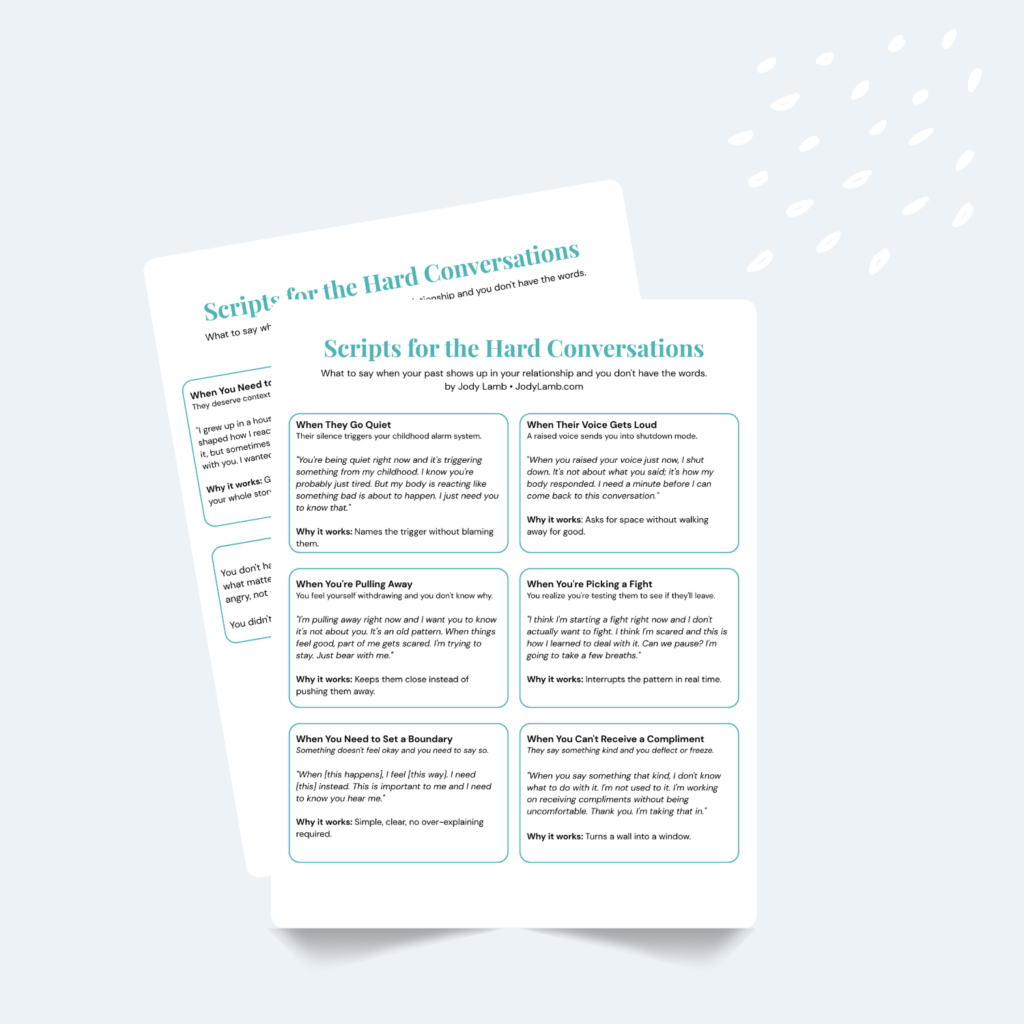
You know what you need to say; you just freeze when the moment comes. Scripts for the Hard Conversations gives you the exact words for setting a boundary, naming a trigger, and telling someone what you need.
How do I actually start overcoming them?
Three things moved the needle for me, in this order:
1. Heal yourself first. The most important relationship work I did had nothing to do with a relationship; it had to do with me. I had to learn to rest, to feel my feelings, to treat myself like someone worth taking care of. This is where your primary job in life becomes taking good care of yourself, not everyone else because self-care isn’t how you get better at relationships someday. It’s how you learn you’re worth loving at all. When I finally did that work, the constant scanning for danger slowed down, and feeling safe in my own body turned out to be the prerequisite for feeling safe with someone else.
2. Learn your boundaries and hold them. Trust doesn’t come from hoping someone treats you well. It comes from knowing that if they don’t, you’ll protect yourself. You have to know what your boundaries are, name them early and calmly, and — the part that changed everything — actually follow through. A boundary without follow-through is just a suggestion. The more I followed through, the more I trusted myself, and the more I trusted myself, the more I could trust someone else.
3. Say the hard thing out loud. Your partner isn’t a mind reader, and your triggers won’t make sense to someone who didn’t grow up the way you did. Early on, my husband came home quiet one night — just tired — and my whole system went to red alert, because in my childhood quiet meant something was about to explode. He’d never have known if I hadn’t told him. So I learned to name it in the moment: “You’re being quiet and my body’s reacting like something’s wrong. Logically I know you’re just tired — I just need you to know.” Naming the pattern breaks it, and it hands your partner a map to your inner world.
Trust in a relationship doesn’t start with trusting the other person. It starts with trusting yourself to handle whatever happens.
Is it too late if I’ve been this way for years?
No. I started this work at 26, focused on it hard through my thirties, and wasn’t in a healthy relationship until I was 38. Seventeen years ago, I couldn’t have imagined the life I have now because I didn’t believe it was available to me. It was.
It’s available to you, too, whether you’re twenty-five and just noticing the patterns or fifty-five and finally understanding where they came from. You didn’t get the blueprint for loving well, and that isn’t your fault but you can build one now. Your trust issues aren’t a sign you’re broken. They’re a sign you survived something, and the same strength that got you through your childhood is what carries you into something better.
You know what you need to say; you just freeze when the moment comes. Scripts for the Hard Conversations gives you the exact words for setting a boundary, naming a trigger, and telling someone what you need.
Frequently Asked Questions
Can trust issues from childhood that affect my romantic relationships actually be fixed, or are they permanent? They’re not permanent. They’re learned survival patterns, which means they can be unlearned at any age. It isn’t fast or dramatic — it’s slow, unglamorous work — but people who’ve had these patterns for decades do change them. I did, starting in my late twenties and continuing well into my thirties.
Why do I feel bored or like there’s no spark with kind, stable partners? Because if you grew up where love and instability lived in the same house, your nervous system learned to read chaos as connection. When someone calm and consistent shows up, the absence of that chaos can feel like something’s missing. That reaction can recalibrate as you heal — stability starts to feel like safety instead of boredom.
How do I explain my triggers to my partner without oversharing? Keep it short, plain, and in the moment. You don’t need your whole life story — just name what’s happening: “When you raised your voice, I shut down. Not because of what you said, but how my body reacted. I need a minute.” Naming it in real time breaks the old cycle and lets the right partner meet you there.