
Why Do I Freeze During Difficult Conversations?
You freeze during difficult conversations because your nervous system learned, a long time ago, that conflict wasn’t just uncomfortable — it was dangerous. When your brain believes it’s in danger, it doesn’t get curious or reach for the right words. It picks one of three options: fight, flee, or freeze. If you were the kid who learned that fighting back made things worse and running wasn’t possible, you became the one who froze — who went blank, went quiet, got very good at reading a room and very bad at speaking up in one. That’s not a communication flaw. It’s a survival adaptation, and it worked. What to do instead is learnable: name what’s happening, own your pattern, and ask for what you need.
I’m Jody Lamb, author and memoirist, and I spent most of my life being the person who held everything together while saying almost nothing about what I actually needed. I grew up as the daughter of an alcoholic mother, and my body learned to go silent long before I understood why.
I go deeper on this in the video.
Why do I freeze during difficult conversations?
Because when you grow up in a home where a parent’s mood could shift without warning — fine at breakfast, terrifying by dinner — your nervous system draws one conclusion and holds it for life: conflict is danger. Not conflict-is-awkward. Conflict is a threat to your safety.
So when the emotional temperature in a conversation starts to rise, your body runs the old program. The words that were in your head two seconds ago vanish. Your chest tightens or your jaw locks, and the only thought left is I don’t know what to say right now. People mistake that for not caring. It’s the opposite — you care so much your system overloads.
You’re not bad at communicating. You were never taught how — you got the blueprint for surviving hard conversations, not for having them.
And here’s the cruel part: survival adaptations don’t come with an expiration date. Your nervous system doesn’t know you’re not eleven anymore. It doesn’t know the person across from you is your partner who loves you, not the parent whose rage you once had to manage. So it protects you the only way it knows how — by shutting you down.
What does shutting down actually look like — Freeze, Fold, or Flood?
It shows up in three main patterns. Most of us have a go-to:
- The Freeze. You go blank. Mid-sentence, mid-feeling, everything stops and you can’t access words — like your brain is buffering. It looks like not caring; it’s actually caring so much your system overloads.
- The Fold. You don’t go blank, you cave. You agree just to end the tension, apologize for things that aren’t your fault, say “you’re right” when you don’t believe it. This one’s sneaky because it looks like communication. It’s not — it’s appeasement, the thing you learned to keep a fragile peace.
- The Flood. The opposite of freezing: everything pours out at once. Suddenly you’re crying, your voice shaking, dragging up something from six months ago and you can’t stop. It’s not that you’re “too emotional” — it’s that you were never given a safe, regular way to let feelings out a little at a time, so when the dam breaks, it’s a wall of water.
Recognize yourself in one of those? Good — naming it is the first step, because you can’t change a pattern you can’t see.
Isn’t going quiet the same as keeping the peace?
This is the belief that keeps so many of us stuck, so I want to challenge it directly. You were trained — not by a teacher, but by the daily experience of an unsafe home — to believe your job was to manage everyone else’s emotions, keep things calm, be the easy one who never asked for too much. And you carried that job into every relationship you’ve ever had.
But here’s the truth I’m living in real time: a relationship where one person can’t say what they need isn’t peaceful. It’s quiet. And those are not the same thing.
Peace is when both people feel safe enough to be honest. Quiet is when one person decided it wasn’t worth the risk. You’ve been choosing quiet your whole life — and it’s exhausting.
So the reframe that changed everything for me is this: your primary job in a relationship is not to keep the peace. It’s to tell the truth about what you need. If you grew up in dysfunction, everything in your body will resist that sentence — which is exactly how you know it’s the work.
What should I say instead? The Name–Own–Ask framework
Here’s the structure I use when I can feel myself starting to shut down. It’s three steps.
- Name what’s happening. Say out loud what’s actually going on inside you — not what the other person did wrong, just your inner experience. “I’m noticing I’m starting to shut down right now, and I don’t want to do that.” You’re not attacking or defending; you’re narrating what’s happening in you. For people who grew up learning to pretend they’re fine, that sentence might be the bravest thing you say all week.
- Own your pattern. Take responsibility for what you tend to do when things get hard — without shaming yourself for it. “I know that when I go quiet, it probably feels like I’m shutting you out. That’s not what’s happening. I’m overwhelmed and trying to figure out what I feel.” This disarms the other person, and it reminds you that this is a pattern, not the truth. You’re not shutting down because you don’t care. Your nervous system is running old software.
- Ask for what you need. This is the step most of us skip entirely, because in childhood, asking was ignored, punished, or used against you. “What I need right now is five minutes to collect my thoughts, and then I want to come back to this.” Or: “I need you to not fix this — I just need you to hear me.” These sentences are short, and they’re some of the hardest words you’ll ever say, because each one requires you to believe your needs matter.
The work isn’t learning a communication technique. It’s learning to believe you deserve to be heard.
Knowing the framework and finding the words when your heart is pounding are two different things, though — so I wrote them out for you. Scripts for the Hard Conversations is a free download with eight word-for-word scripts for the exact moments you freeze: when you need a break and don’t know how to ask, when your past shows up in your relationship and you have no language for it. Grab it below.
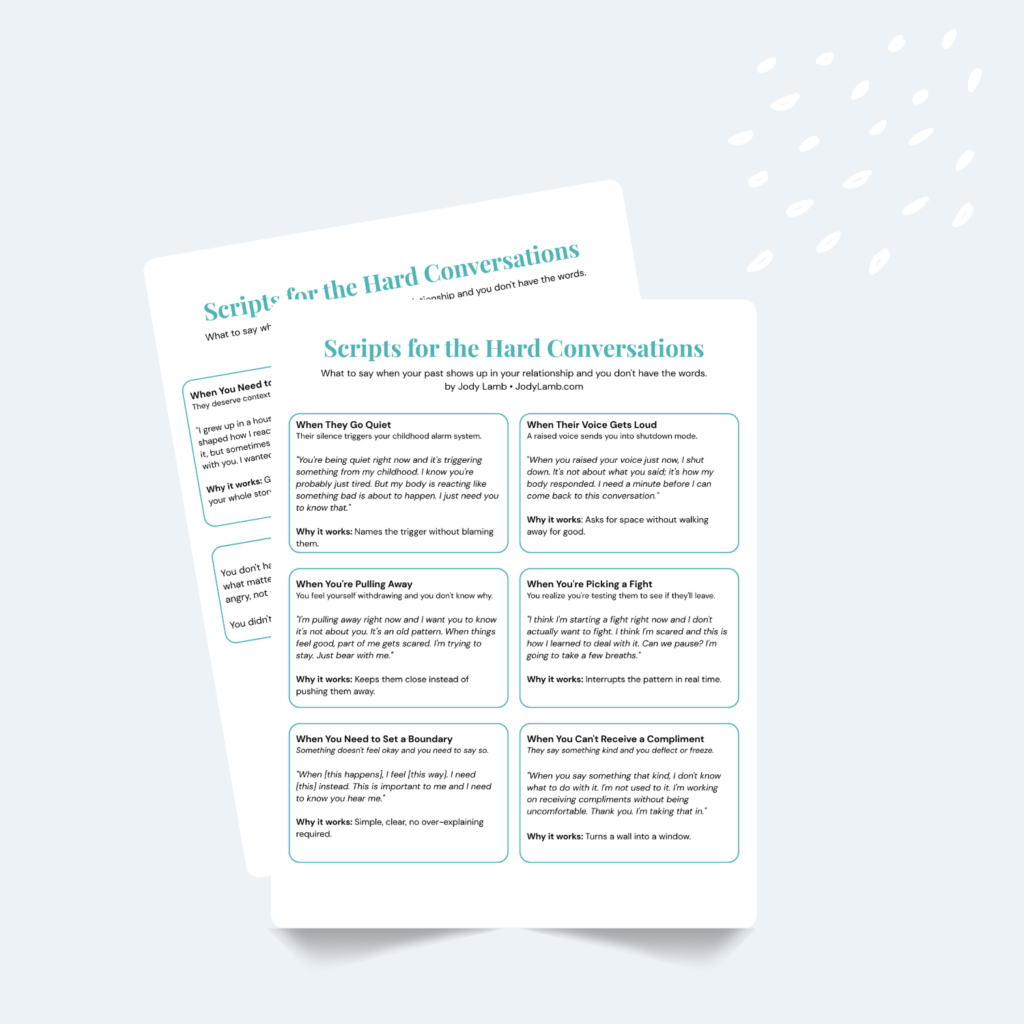
You know what you need to say — you just freeze when the moment comes. Scripts for the Hard Conversations gives you the exact words for setting a boundary, naming a trigger, and telling someone what you need.
If you recognized yourself in every part of this, it doesn’t mean something’s wrong with you. It means you survived something, and adapted so well that most people have no idea what it cost you. You’re not bad at relationships — you were never given the blueprint. And learning to say “this is what I need” to someone who actually wants to hear it isn’t harder than what you’ve already survived. It’s just different.
Your primary job in life is to take good care of yourself — not other people — and part of that is learning to say what you need out loud, even when it’s terrifying. This is the whole story of my memoir, My Job Is Me, the shutting down, the caretaking, the years I spent trying to save someone I couldn’t, and the moment I realized my job was to take care of myself. If anything here hit home, that book was written for you. The scripts are here to help you start today.
You know what you need to say — you just freeze when the moment comes. Scripts for the Hard Conversations gives you the exact words for setting a boundary, naming a trigger, and telling someone what you need.
Frequently Asked Questions
Why do I freeze or go blank during arguments? Because your nervous system learned early that conflict equals danger, so when a conversation heats up, it runs a freeze response to protect you. The words disappear and your brain feels like it’s buffering. It looks like you’ve checked out or don’t care, but it’s usually the opposite — you care so much your system overloads. It’s a survival adaptation, not a character flaw.
Why do I immediately apologize or cave when someone criticizes me? That’s often the fawn response — appeasing to defuse a perceived threat. If you grew up where any mistake could trigger a disproportionate reaction, you learned to grovel fast to stay safe. As an adult it looks like agreement, but it’s actually self-abandonment: you absorb the other person’s feelings and abandon your own. Naming it in the moment is how you start to interrupt it.
How do I say what I need without it turning into a fight? Use a simple three-step structure: name what’s happening inside you, own your own pattern, then ask for what you need — plainly, as your experience rather than an accusation. Something like, “I’m noticing I’m shutting down, that’s a pattern of mine, and what I need is a few minutes before we keep going.” Owning it instead of blaming tends to lower the other person’s defenses and invite them in.