

Why Am I So Hard on Myself?
You’re so hard on yourself because being hard on yourself was once a survival strategy. If you grew up in a home where love felt conditional and mistakes felt dangerous, you learned to catch your own flaws before anyone else could, because spotting them first was how you stayed safe. That inner critic isn’t random and it isn’t the real you. It’s an old alarm system that’s still going off long after the danger has passed.
I’m Jody Lamb, author and memoirist, and for years I assumed I was simply built to be brutal with myself — that some people were gentle with themselves and I just wasn’t one of them. I grew up in a home affected by my mother’s alcoholism, and a relentless inner critic was one of the things I carried out of that house and into adulthood. Truth be told, I still struggle with this!
I go deeper on this in the video.
Where does the inner critic actually come from?
It comes from what you learned when you were too young to know anything different. In a home shaped by addiction or chaos, you pick up a specific set of lessons: that love is conditional, that you’re safe when you’re useful and quiet and no trouble, that your value is about what you can do for people rather than who you are.
You learn to scan the room the second you walk in — to read moods, to adjust yourself to whatever everyone else needs. And you learn that mistakes aren’t just mistakes. They’re dangerous. They can set someone off and make things worse. So you try to be perfect, because perfect feels like safety.
Here’s the part that matters: when you grow up like that, you don’t only learn to watch other people closely. You learn to watch yourself. You become your own harshest critic because catching your flaws first feels like the way to stay out of trouble and finally be good enough.
Being hard on yourself was never a character flaw. It was a survival strategy you built when you were too young to know any different.
How does being hard on yourself show up now?
The problem is that the strategy doesn’t switch off just because you left home. It follows you into your job, your relationships, your parenting, your quiet moments alone. See how many of these you recognize:
- You can’t take a compliment. Someone says something kind and your brain instantly argues with it — they’re just being polite; if they knew the real me, they wouldn’t say that.
- You apologize for everything. You say sorry when you’ve done nothing wrong, over-explain, and make yourself smaller than you need to be.
- You hold yourself to impossible standards. Standards you’d never apply to anyone else — then you feel like garbage when you fall short of them.
- You replay your mistakes on a loop. The awkward thing you said three years ago is still with you at 2 a.m.
- You won’t let yourself rest. Rest feels lazy, and lazy feels dangerous, so you push until your body forces you to stop.
- You think everyone else is doing better. You’re convinced you’re behind, failing, the only one who hasn’t figured it out.
That voice isn’t telling you the truth. It’s an old alarm system still going off even though the danger has passed.
None of that means you’re broken. It means you learned, a long time ago, that being hard on yourself was how you survived and your nervous system simply hasn’t caught up to the fact that you’re not in that house anymore.
What’s actually true about that voice?
Here’s what I wish someone had told me years ago.
That voice feels like the truth and feels like it’s protecting you, but it’s neither. It’s a terrified kid trying to keep you safe the only way they knew how. You can thank it for trying and still stop letting it run the show.
You’re also not behind. There’s no timeline you’re failing to hit, no checklist you’re botching. You’re doing the best you can with what you were given and what you were given wasn’t much. The fact that you’re here, trying to understand yourself, is not nothing. That’s the whole thing.
And you deserve the same grace you hand everyone else. I know you make room for other people’s mistakes and imperfections. This is where your primary job in life becomes taking good care of yourself — not just everyone else — because you’re not the exception to compassion.
You don’t have to earn your own compassion. You’re allowed to be a human being who sometimes falls short.
If this is landing, the blueprint I made walks you through the first steps of learning to do that — link below.
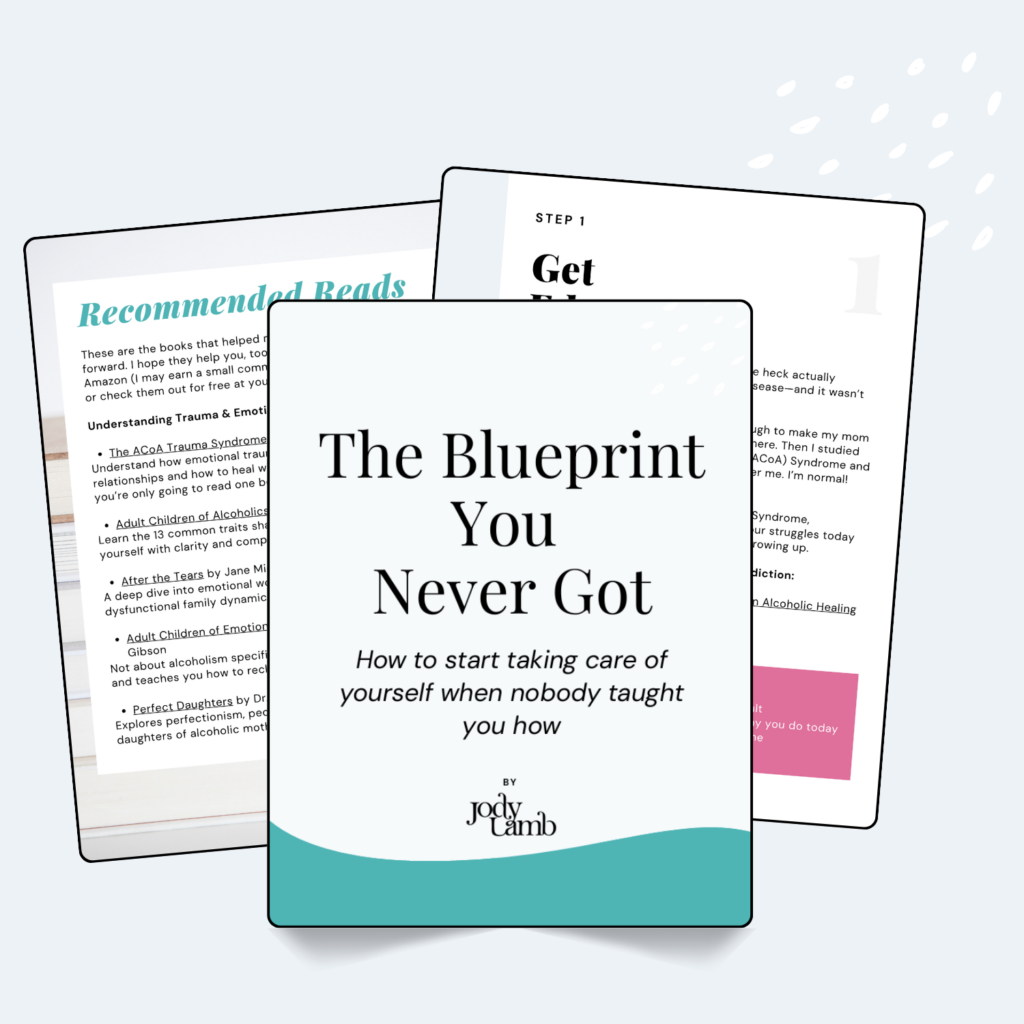
You spent years taking care of everyone else. The Blueprint You Never Got is the free guide to finally taking care of you — the thing nobody ever taught you how to do.
How do I stop being so hard on myself?
You don’t do it by trying to silence the voice through willpower. You do it by slowly changing your relationship to it. Four things that helped me:
- Notice the voice. When it starts in, just pause and name it: oh, there’s the critic again. You don’t have to fight it or believe it; seeing it as an old pattern instead of the truth already loosens its grip.
- Ask what you’d say to a friend. If your best friend brought you the exact “failure” you’re beating yourself up over, you wouldn’t tear them apart. You’d be kind! Try talking to yourself that way. It feels awkward at first. Do it anyway.
- Let “good enough” be enough. Perfection was never the goal. The dinner you made, the email you sent, the way you showed up today even though you were exhausted — good enough. You don’t have to be exceptional to deserve rest, love, or peace.
- Remember where it came from. When the critic gets loud, remind yourself: this isn’t me, this is what I learned, and I’m allowed to unlearn it. You didn’t choose to be this hard on yourself. You can choose, now, to try something different.
The voice may never disappear completely. But it can get quieter, and it can lose its power over you. It’s true, and I’ve lived it.
You became your own harshest critic because you were trying to survive, and it worked; it got you through. But you don’t have to live like that anymore. That voice that says you’re not enough is lying. You are enough. You always were. You just didn’t have anyone around to teach you that, so now you get to teach yourself.
You didn’t get the blueprint for being kind to yourself, so I made you one. The Blueprint You Never Got is a free guide that walks you through taking care of yourself when no one ever showed you how. It’s the roadmap I wish I’d had. Grab it below.
You spent years taking care of everyone else. The Blueprint You Never Got is the free guide to finally taking care of you — the thing nobody ever taught you how to do.
Frequently Asked Questions
Why am I so hard on myself but not on other people? Because you learned self-criticism as protection. Catching your own flaws first felt like the way to stay safe. You naturally extend grace outward to others, but somewhere early on you filed yourself as the exception who has to earn it. That’s a learned pattern, not a fixed trait, and it can change.
Is being hard on yourself a trauma response? For many people who grew up around addiction or chaos, relentless self-criticism and perfectionism did develop as survival responses to an unsafe environment. It’s less about a formal label and more about recognizing that the pattern had a cause. You weren’t born this way, which means you can unlearn it.
Can you actually quiet your inner critic for good? The voice may never vanish entirely, and that’s okay. What changes is its power over you. As you learn to notice it, question it, and choose a different response, it gets quieter and stops running the show — and the moments of self-compassion get easier to reach.