How Do I Build Healthy Relationships After a Difficult Childhood?
You build healthy relationships after a difficult childhood by understanding that your intense reactions to ordinary relationship moments usually aren’t about your partner at all. They’re your nervous system replaying the past and then learning to create a gap between the trigger and your response. You name the pattern you fall into, catch yourself in the heat of the moment, find words for what’s happening inside you, and practice small moments of letting someone in. It’s slow, and it isn’t linear, but the template you were handed as a kid can be rewritten.
I’m Jody Lamb, author and memoirist, and for a long time a simple “we need to talk” text could send my whole body somewhere else entirely — chest tight, jaw locked, certain it was all falling apart. I grew up in a conflict-filled home, and I was trying to build something healthy with a body that was still bracing for war.
I go deeper on this in the video.
Why do I overreact to normal relationship moments?
Because your nervous system isn’t broken; it’s doing exactly what it learned to do. If your home was unpredictable, if you never knew which version of a parent was coming through the door, your brain got very good at scanning. You learned to read the weight of a footstep, the length of a pause, the way a cabinet closed. That skill kept you safe.
The problem is you’re now bringing that same surveillance system into your adult relationships, and your partner isn’t your parent but your body doesn’t know that yet. So when they raise their voice slightly, even playfully, your body doesn’t hear playful; it hears danger. When there’s silence after a disagreement, it doesn’t hear “they need a minute”; it hears abandonment.
You’re not overreacting. You’re over-remembering. Your body is responding to the past as though it’s happening right now.
Once you understand that, everything starts to shift. This isn’t a character flaw. It’s a survival response that’s still running long after the danger passed.
What patterns do people from conflict-filled homes fall into?
There are four I see again and again in the comments and notes from this community, and most people are running at least two without realizing it. See which one you feel in your chest:
- The Fixer. You learned that managing everyone’s emotions could prevent the explosion, so now you over-function — anticipating needs before they’re spoken, smoothing wrinkles before they form. You’re exhausted, because you’re doing the emotional labor of two people, and you’ve been doing it since you were seven.
- The Runner. The moment things get intense, you check out. You leave the room, go quiet, or say “I’m fine” when you’re anything but. You learned the safest place during conflict was somewhere else — and now, every time your partner needs to go deeper, you disappear.
- The Tester. You don’t trust that anyone will actually stay, so you unconsciously create situations to find out. You pick fights, pull away to see if they pursue, withhold to see if they notice. You’re constantly auditing the relationship, because you learned love has conditions.
- The Performer. You became the version of yourself you believe is most lovable — agreeable, easy, no needs. In childhood, having needs got you punished or ignored, so you stopped having them out loud. Now your partner knows the role you play, not you.
Whichever one you felt in your chest — that’s your pattern. And naming it is the beginning of not being controlled by it.
How do I stop the old pattern from taking over in the moment?
Knowing your pattern intellectually is one thing. Catching it in real time — when your partner just said something and your whole body is activated — is where the real work happens.
Here’s the practice I use. When you feel yourself getting activated — heat rising, walls going up, the urge to shut down or blow up — pause for three seconds and ask one question: how old do I feel right now? Not how old you are. How old you feel. Because in that moment you’re probably not a thirty-something having a disagreement; you feel like a nine-year-old hearing parents scream through the wall.
In the middle of a fight, the question isn’t how old are you. It’s: how old do I feel right now?
Naming that creates a gap between the trigger and your response — and that gap is where healing lives. The next hard part is opening your mouth, because most people freeze right there or say the defensive thing that sounds like their own parent. So it helps to have language ready. Instead of shutting down: “I’m noticing I’m pulling away, and I don’t want to. Can you give me a minute? I’m not leaving, I just need to land.” Instead of exploding: “I’m getting activated and I don’t think my reaction matches what’s actually happening. I need to slow down.” Instead of performing: “I’m struggling with something and I don’t want to pretend I’m okay when I’m not.”
Finding words for experiences that happened before you had language for them is genuinely hard. If you wouldn’t know where to start, I made you a free download — Scripts for the Hard Conversations — with word-for-word language for exactly these moments. Link below.
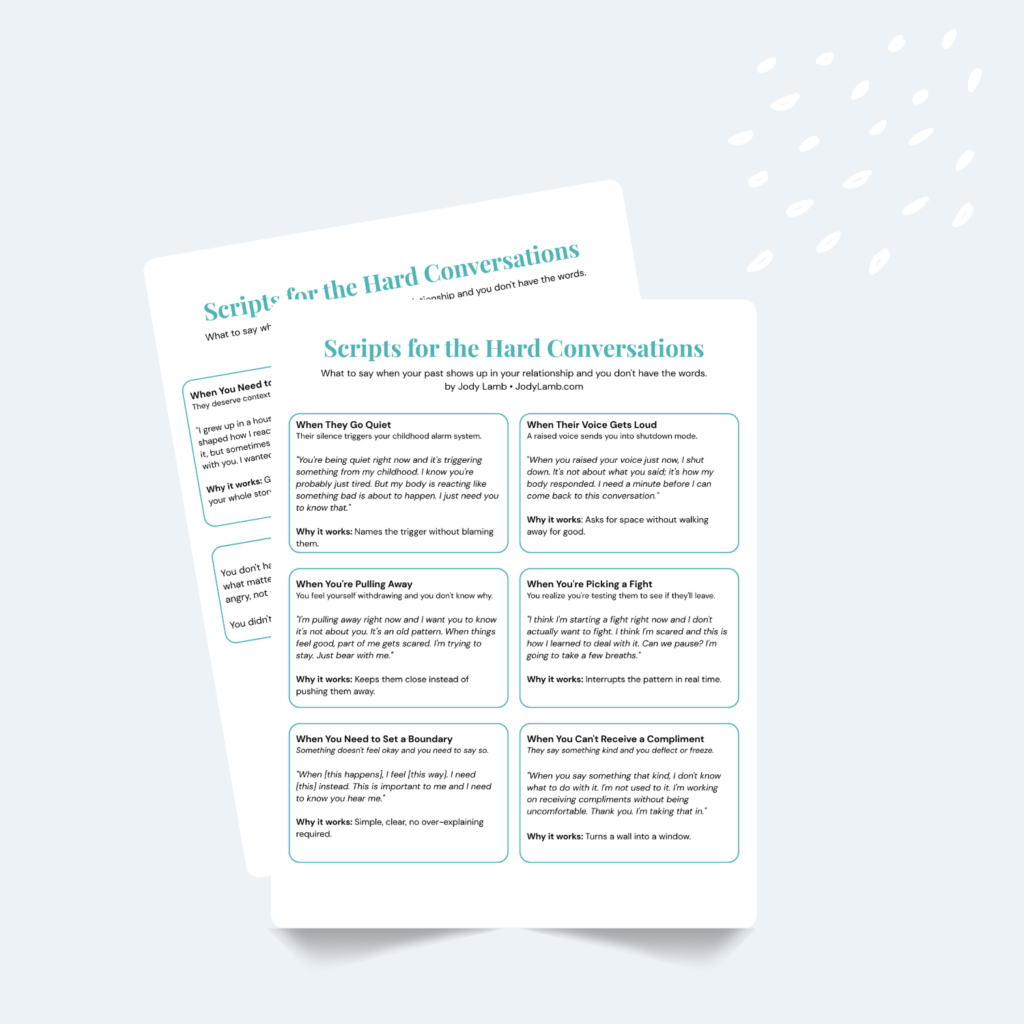
You know what you need to say — you just freeze when the moment comes. Scripts for the Hard Conversations gives you the exact words for setting a boundary, naming a trigger, and telling someone what you need.
What’s the one daily practice that actually rewires closeness?
One small moment of chosen vulnerability, every day, with someone you trust. Not a trauma dump, not a confession — just one moment where you let yourself be seen in a way that feels slightly uncomfortable.
Maybe it’s “I had a hard day and I don’t need you to fix it, I just want to sit with you.” Maybe it’s “I felt jealous earlier, and I know that’s my stuff, not yours.” Maybe it’s as simple as “I need a hug” — and meaning it. When you grew up in conflict, your body learned that vulnerability equals danger. Every time you let someone in and they respond with warmth instead of harm, you hand your nervous system new evidence.
Every time you let someone in and they respond with warmth instead of harm, you’re teaching your body that closeness doesn’t have to hurt.
You won’t trust it at first — your body has years of evidence saying otherwise — but one small moment at a time, the old story loses its grip. This is also where your primary job in life becomes taking good care of yourself, not just managing everyone else: learning to name your needs is self-care, and it’s the ground healthy love grows from.
The fact that you’re here, trying to build something healthier than what you were given, says the cycle doesn’t get to win. You’re not too damaged for love, and you’re not too broken for a healthy relationship. You’re someone who survived something hard and is learning a new way to be close — and that takes real courage. If you want the words to start, Scripts for the Hard Conversations is my free guide with eight word-for-word scripts for the moments your past shows up in your present. Grab it below — you don’t have to figure out the language alone.
You know what you need to say — you just freeze when the moment comes. Scripts for the Hard Conversations gives you the exact words for setting a boundary, naming a trigger, and telling someone what you need.
Frequently Asked Questions
Why do I panic or shut down during conflict with my partner? Because if you grew up in a high-conflict home, your nervous system learned early that conflict meant danger, so it reads an ordinary disagreement as a threat and reacts to protect you. It’s a survival response, not a character flaw or a sign you’re bad at relationships, and it can change with awareness and practice.
Can you have a healthy relationship if you grew up in a dysfunctional home? Yes. The template you absorbed as a child isn’t your destiny. When you can recognize your patterns, catch your reactions in the moment, and slowly teach your body that closeness is safe, you can build relationships that are about the person in front of you rather than the past behind you. It’s gradual work, but it’s real.
How do I explain my triggers to my partner without it turning into a fight? Name what’s happening inside you, in plain language, in the moment — before the reaction takes over. Something like, “I’m getting activated and my reaction doesn’t match what’s actually happening between us. I need to slow down.” Owning it as your experience, rather than an accusation, tends to lower the temperature and invite your partner in instead of putting them on the defensive.